
Current and Future Developments in English Assessment with Cambridge OCR
Join Cambridge OCR English specialists to explore GCSE & A-Level developments, implications of the CAR, and OCR’s new Oracy qualification.
At this event – with a secondary focus – we will be hearing from two English specialists at the Awarding Body ‘Cambridge OCR’. The event will cover recent (and planned) developments in English assessment at both GCSE and A-Level, as well as implications for further changes following the publication of the Curriculum and Assessment Review. The event will also present an opportunity to consider Cambridge OCR’s new qualification in Oracy. There will be an opportunity for discussion and to ask questions.
Sam Orciel – Lead Subject Advisor for A Level English quals
Before joining Cambridge OCR in September 2022, Sam spent ten years teaching a range of English qualifications in secondary schools, including as a head of department. She did this alongside completing a MSt in Advanced Subject Teaching at the University of Cambridge, specialising in A Level English curricula and pedagogy.
Lydia Ridding – Subject Advisor for Entry Level, GCSE and Oracy (VQ)
Prior to joining Cambridge OCR in June 2023, Lydia spent 20 years working in a range of sixth form colleges across the country, teaching A Level and GCSE qualifications in English. She was a coursework moderator with Cambridge OCR for a number of years and has an MA in Victorian Studies from Birkbeck University.
Date: Thursday 11th June
Time: 4.00 pm to 5.30pm
Location: online
Cost: Members plus one guest free. Non-members £5
Please book through Eventbrite here
Secondary reading: what do we know and what can we do?
This session will cover evidence on secondary reading, the CPD and practical strategies for the English classroom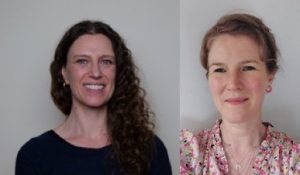
Lucy Floyer and Professor Jessie Ricketts worked together with a large team of secondary practitioners to develop Continuing Professional Development (CPD) for all secondary staff on supporting reading in all pupils. This CPD was launched by the Department for Education in April 2025 and is freely available. In this session, Jessie will present evidence on secondary reading, Jessie and Lucy will talk about the CPD and Lucy will cover practical strategies for the English classroom.
Professor Jessie Ricketts is based in the Department of Psychology, Royal Holloway, University of London and directs the Language and Reading Acquisition (LARA) research group. Jessie researches language and literacy in children, young people and adults. She is particularly interested in how reading benefits children’s learning and language. Jessie works closely with teachers, educational charities and policy makers to conduct research and consider its implications for education.
Lucy Floyer has over 25 years of experience as a teacher, including 18 years of leadership and advisory work in schools. She has led at school and trust leadership level across primary, secondary and special education, and in both inner city and suburban schools. Within her literacy leadership roles, Lucy has led whole school and trust INSET including delivering keynotes and conferences; supported middle leaders in integrating subject-specific literacy development into their curriculum design; and trained subject teachers in implementing literacy strategies in the classroom. She has led and supported senior leaders and literacy leads on the design and implementation of whole school literacy development plans across a range of organisations. She is an expert in teenage reading support and has worked on reading projects for GL Assessment and the DfE.
Date: Monday 11th May 2026
Time: 4.00 pm to 5.30pm
Location: online
Cost: Members plus one guest free. Non-members £5
Please book through Eventbrite here
The Place and Case for Oracy in the National Curriculum with Sonia Thompson
 This session will present evidence from the EEF, Oracy Commission and the CAR and locate the place and case for oracy in the classroom.
This session will present evidence from the Education Endowment Foundation, the Oracy Commission findings and the Curriculum and Assessment Review and locate the place and case for oracy in the classroom. It will also offer some practical strategies for embedding oracy, across the curriculum.
The 2024 National Curriculum contained ‘spoken word’ statements, which schools implemented with varying degrees of breadth and depth. With the formation of the Oracy Commission, talk was positioned as ‘the 4th R’, with calls for its status to firmly embedded within the Curriculum and Assessment Review. This session will examine the evidence and reflecting on how oracy supports cognitive development, improves classroom dialogue, and enhances pupils’ confidence and agency. It will also examine the leadership actions required to create a culture where spoken language is valued, explicitly taught and consistently embedded, across the curriculum.
The session will be run by Sonia Thompson who is the Headteacher at St Matthew’s C.E. Primary School and the Director of St Matthew’s Education Endowment Foundation (EEF), Research School, in Nechells Birmingham. Her school regularly hosts’ visits for Teachers, Headteachers and MATs, from across the country and internationally, who want to see evidence-informed practice across the curriculum.
Sonia is the author of ‘An Ethic of Excellence in Action’ and is a trustee for the Church of England National Education Society, Classics for All and the Education Endowment Foundation (EEF). Sonia has been a member of several DFE External Reference Group, including The Writing Framework and was a commissioner on the Oracy Education Commission. Most recently, Sonia has become a trustee for the charity Voice 21. St Matthew’s has run two oracy modules programmes, with Oracy Cambridge. Sonia is regularly asked to deliver keynotes and training at various conferences and events, across the country and internationally.
Date: Thursday 30th April
Time: 4pm to 5.30pm
Location: online
Cost: Members plus one guest free. Non-members £5
Please book through Eventbrite here
NAAE roundtable: The future for English – reviewing outcomes from the CAR final report and DfE response.
Following publication of the Curriculum and Assessment Review’s final report and the DfE’s response (November 2025), we’d like to invite NAAE members to join us for an informal professional dialogue of the recommendations and next steps.
We are delighted to welcome Dr Becky Fisher, Chief Executive Officer of the English Association, who will open the event with a concise overview, setting the stage for discussions. We’ll then move into smaller groups to discuss and network with colleagues, supported by members of the NAAE Committee.
This is an exclusive event for NAAE members and their registered guests to join us for an informal professional dialogue.
Dr Becky Fisher is the Chief Executive Officer of the English Association. Her interests include early English language and literature, playfulness in education, and bringing academics, independent scholars, and the public together. Alongside her role at the EA, Becky also sits on the Board of Directors for the Council for Subject Associations, an umbrella organisation that represents subject associations nationally and allows them to speak with a single voice on key issues and consultations. As a Director of the CfSA, Becky is building links between subjects for mutual advocacy, and strengthens the EA’s connections with policy makers and other key stakeholders in the education landscape.
Date: Monday 2nd February
Time: 4.00 pm to 5.30pm
Location: online
Cost: Free. Members and registered guests only.
Please book through Eventbrite here
The National Year of Reading 2026 – a special event for strategic leaders of English with Martin Galway (Head of Professional Learning and Partnerships, National Literacy Trust)

Martin will give us an overview of the scope and ambition of the NYR, signposting the experiences and resources available to schools, settings and the wider community and highlighting how advisers, consultants and strategic English leads can support the campaign.
Martin Galway is the Head of Professional Learning and Partnerships at the National Literacy Trust. He is a Fellow of the English Association and previously worked as a teaching and learning advisor for the Herts for Learning Primary English Team. Martin is a former primary school teacher. His interests include early reading development and reading fluency instruction, grammar, literacy difficulties, and oracy. Martin is a regular speaker at national and international conferences on all aspects of English and literacy.
Date: Saturday 24th January
Time: 10.30am to 12pm
Location: online
Cost: Members plus one guest free.
Please book through Eventbrite here
NAAE’s ‘Spotlight on practice….’
Addressing potential unintended consequences of the writing framework: Promoting the reading-writing connection using mentor texts as part of a book-based curriculum.
Our ‘spotlight on practice’ events are intentionally designed for a wider audience, particularly school-based staff, such as teachers, English subject leaders and school leaders. This session is most suitable for colleagues working with children in Years 3-8.
We are delighted to be working with HfL Education’s and friend of NAAE, Ellen Counter again.
In this session, Ellen will discuss how to make meaningful connections between reading and writing in the primary-KS3 classroom by developing pupils’ ability to read as writers. The approach goes beyond comprehension, encouraging children to notice and apply writers’ craft techniques in their own writing. As it states within the writing framework, “to develop their understanding of the structures of different types of text, pupils need to study model texts which ‘provide opportunities to read, analyse, and emulate models of good writing’” (p. 104). This session will explore how to select mentor texts, build habits of noticing craft moves (e.g., language choices, sentence structure, punctuation) and confidently teach pupils to apply these techniques in writing.
Ellen Counter is Deputy Lead Adviser for Primary English at HfL Education (formerly Herts for Learning) and has an MA in Children’s Literature. She has taught in three different London boroughs since 2007 and now enjoys working with colleagues in Hertfordshire schools and beyond.